Length, width, and height โ measured to the outside of your gear in millimeters or inches. Here's how to get them right.
Not every ruler is created equal. Here's how the common options stack up for case work, ranked by how reliable a number you'll get.
Our Measuring Kit packs the two we reach for most, plastic vernier calipers and a 3 meter steel tape measure, into one box for $12 with free shipping.
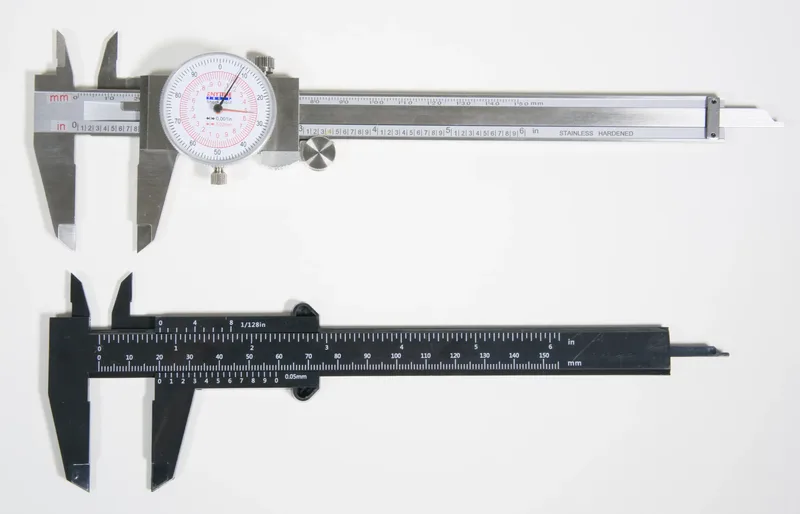
The right tool for the job. Reads to 0.01mm, jaws give you a true outside dimension, and depth-rod handles recessed features.
Plastic-jawed versions are safe around glass.
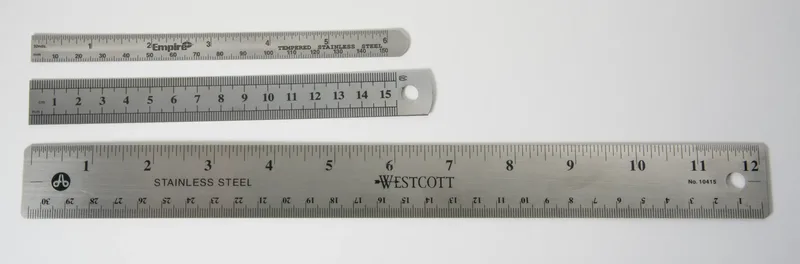
For objects smaller than 150mm, a 6" steel rule with crisp millimeter markings is hard to beat. Stiff, square edges, and you can read down to 0.5mm with a steady eye.
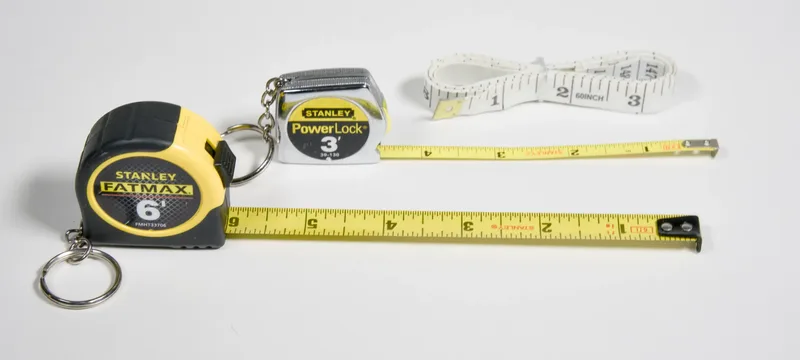
Metal tape measures are fine for large items where about 2mm of accuracy is good enough.
Do not use soft fabric tape measures.
They sag, stretch, and curl around the object instead of measuring across it.
Fine for length on larger items where a few tenths of a millimeter don't matter. Make sure the zero mark is at the very edge โ many rulers start a millimeter or two in.
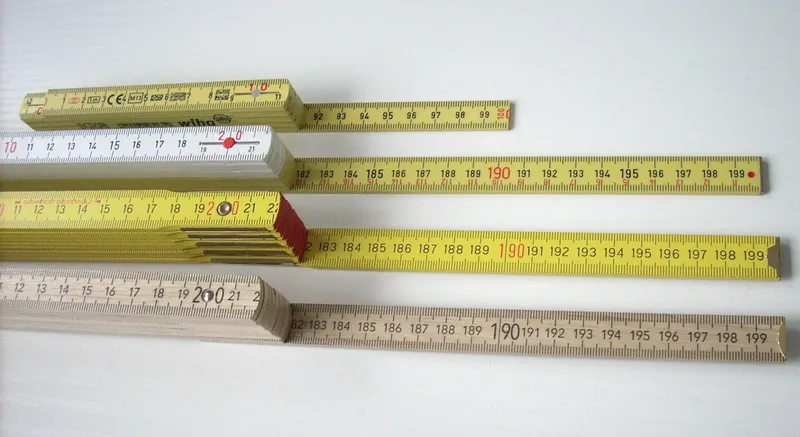
Photo: Wikimedia Commons ยท CC BY-SA 3.0
We accept either millimeters or inches. Millimeters give the tightest fit and are easier to read. Whichever you pick, stick with it for all three measurements.
Most gear falls into one of two shape families. Pick the one that matches yours โ the way you measure changes slightly between them.
Measured by diameter at the widest point and total length.
Measured by length, width, and height of the bounding box.
Imagine the smallest rectangular box your gear would fit inside if everything were rigid. That's what we're building. Measure to the widest point in each axis โ protruding lens caps, eyecups, knobs all count.
The case builder form has an option for the object "fit" which is added in all dimensions, 0โ3mm. If your gear has a removable strap, hood, or eyecup, measure with it on if you carry it that way.
Some objects are hard to measure accurately. Before you order, contact us and we'll help you get the right fit the first time.
Most cylindrical objects taper. A camera lens is wide at the rear flange and narrows toward the front element; a bottle bulges in the middle and pinches at the neck. Always measure the largest diameter โ that's the dimension the case has to clear.
Calipers give you a true diameter in one shot. If your calipers aren't long enough to span the widest point, measure across with a hard ruler held square to the object โ we'll have a photo of this technique here.
For lenses, eyepieces, and anything with an exposed coated surface, use plastic or nylon calipers. Steel jaws will scratch front elements and fine finishes the moment they slip.
For a true cylinder, send the diameter at the widest point and the total length. We'll cut the cavity to match โ no need to compute a bounding box.
Pick a standard size and we make it to order, or measure your gear for a case built to its exact shape.
Not sure which way to go? Talk to us.